Submitting a Bachelor’s or Master’s thesis is the final stage of a long academic project. After months of research, writing, analysis, and revision, students must make sure the finished document is presented clearly and delivered in the required format. Digital submission may be part of the process, but many universities, supervisors, and examination offices still request printed and bound copies.
Professional printing is not only about putting pages on paper. The final result should be readable, durable, visually consistent, and suitable for the rules of the university. Students in Germany who want a convenient online process can explore services such as TesiLab thesis printing, which allows users to upload a PDF, choose a binding, preview the order, and arrange delivery within Germany.
Confirm the university requirements first
Before choosing paper, cover color, or binding style, check the formal requirements for the degree program. Universities may specify the number of copies, page format, paper size, cover type, title-page layout, or submission deadline. Some departments may prefer a particular binding, while others allow students to choose from several professional options.
It is also important to check whether the university requires printed copies in addition to a digital file. The required number may include copies for an examination office, supervisor, company, or personal archive. Ordering all necessary copies together can reduce the risk of forgetting one at the last minute and may make the overall price more efficient.
Proofread the final PDF
A print service reproduces the file that is uploaded, so the PDF should be checked carefully before placing the order. Review the title page, table of contents, page numbers, headings, footnotes, bibliography, figures, and appendices. A small formatting error that is easy to overlook on a screen can become much more noticeable in a bound document.
Check that fonts are embedded correctly and that tables, charts, and images appear as intended. Page breaks deserve particular attention. A heading at the bottom of a page, a nearly empty page, or a figure separated from its explanation can affect the professional appearance of the thesis.
It is wise to open the PDF on more than one device or use a print-preview function before ordering. If possible, ask a classmate or supervisor to review the final version as well. Once the document is uploaded, compare the online preview with the file on your computer to ensure that the correct version has been selected.
Choose a binding that suits the purpose
The best binding depends on the university’s rules, the expected durability, the budget, and the number of copies required. A hardcover can provide a formal and long-lasting presentation, making it suitable for an important final document or an archive copy. It may also allow details such as a title, author name, or year to be added to the cover or spine.
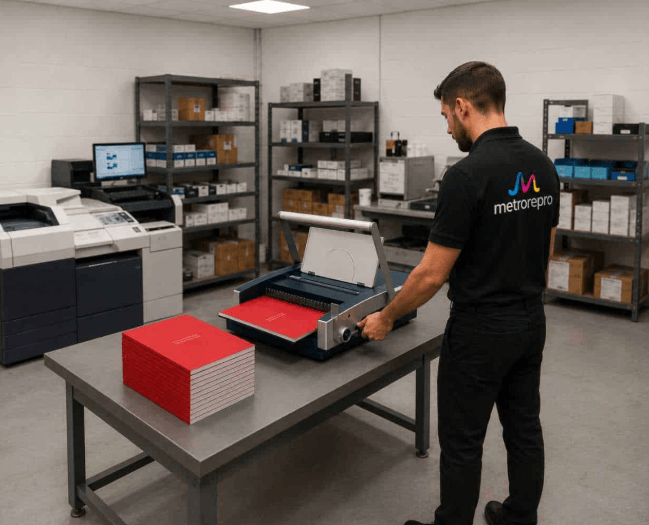
A softcover offers a lighter and more flexible alternative while maintaining a professional appearance. It can be practical for students who need several copies or want a bound thesis that is easy to handle. Klebebindung, or adhesive binding, is often a cost-conscious option for academic papers, project reports, and copies that do not need the same rigid cover as a premium hardcover.
Students should compare the maximum page capacity, cover materials, finishing options, and estimated production time before making a decision. The cheapest option is not always the best choice if the document is very long or must be stored for many years.
Consider paper and print quality
Paper selection affects both readability and the physical feel of the finished thesis. Black-and-white printing may be suitable for primarily textual work, while color printing is important when charts, maps, photographs, or diagrams contain information that would be lost in grayscale. Students should review pages with color elements carefully and decide whether every color page is necessary.
Plan around production and delivery time
Last-minute printing creates avoidable pressure. Students should allow time for the final proofreading, file upload, preview, production, delivery, and any unexpected issue. Online services may offer fast production, but the exact delivery time can depend on the order type, location, weekday, and shipping method.
For example, TesiLab states that standard production can be completed within 24 hours and that delivery in Germany generally takes 48–72 hours, with free shipping listed on its website. Students should still review the current conditions, order cut-off times, and any express options before relying on a particular schedule. It is sensible to order several days before the official deadline whenever possible.
Make the cover simple and accurate
The cover is the first part of the thesis that people see, but it should remain consistent with academic requirements. Confirm the spelling of the title, the author’s name, degree program, university, department, and submission year. Avoid making decorative choices that reduce readability or conflict with official guidelines.
A restrained finish, readable lettering, and a suitable material usually create a more professional result than excessive decoration. If cover embossing or foil lettering is available, proofread the exact text in the preview before approving the order.
Treat printing as part of the submission process
Professional thesis printing is easier when it is planned as part of the academic workflow rather than left until the final hours. Confirm the university rules, proofread the PDF, inspect the online preview, choose a suitable binding, and allow enough time for production and delivery. These steps reduce the chance of receiving an incorrect or damaged copy when the deadline is approaching.
A carefully prepared printed thesis gives the work a durable physical form and helps present months of research in a clear, organized way. With the right file preparation and a reliable printing service, students can complete the final stage of their degree with greater confidence.