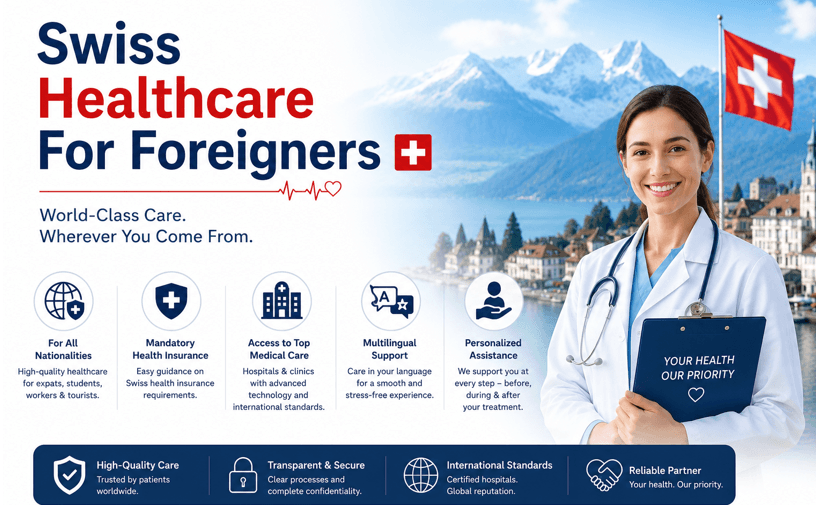
Deciding to seek medical treatment in Switzerland is rarely a casual choice. Most people arrive at that decision after a long road, and by the time they start researching, they need answers, not more uncertainty. The system is excellent, but it is also unfamiliar territory for most international patients. Knowing how Swiss Healthcare For Foreigners actually works in practice, what to prepare, and what to expect, is what makes the difference between arriving confident and arriving overwhelmed.
The good news is that Switzerland welcomes foreign patients across both private and university clinics, and the standard of care genuinely lives up to its reputation. What makes the difference between a smooth experience and a stressful one is rarely the medical system itself. It is the preparation that happens before arrival. Understanding what to bring, who to contact, how decisions get made, and what to expect at every stage transforms an unfamiliar process into a manageable, even reassuring one.
How International Patients Can Access High-Quality Swiss Healthcare For Foreigners
Foreign patients are genuinely welcome at Switzerland’s leading private and university clinics, but access is not automatic. Without proper coordination, securing the right appointments, meeting documentation requirements, and reaching the right specialists can take far longer than expected. For anyone managing a serious diagnosis, those extra weeks are not just frustrating. There are times when most patients simply cannot afford to lose.
Four Key Aspects of Swiss Medical Care Every Foreign Patient Should Know
These five factors shape the entire experience from the very first outreach to post-treatment follow-up care back home. Understanding them before the trip means fewer surprises, smoother coordination, and a much better chance of getting the right care from the right specialist without unnecessary setbacks along the way.
Choosing the Right Specialist Matters More Than the Hospital
Switzerland has some of the finest hospitals in the world, but the outcome of any Swiss Healthcare for Foreigners depends far more on the specific doctor handling the case than on the name above the door. Two specialists working within the same clinic can have very different levels of experience with a particular condition, and that distinction matters enormously when the diagnosis is serious.
Medical Documents Are the Foundation of Everything
Arriving with properly prepared medical records is not a paperwork formality. Swiss specialists review documentation carefully before agreeing to take on a case. Incomplete files, poor translations, or missing diagnostic results can push the process back by weeks, creating delays that are entirely avoidable with the right preparation done before making the first contact.
Language Is Rarely the Barrier People Expect
Most senior physicians at leading Swiss private clinics communicate confidently in English, and many speak additional languages depending on their patient base. Having someone who understands both the medical context and the cultural nuances of the consultation ensures that nothing important gets lost, misread, or overlooked during what is often a critical conversation about a patient’s care.
The Real Cost of Swiss Treatment Is Worth Understanding
The cost of treatment is slightly higher than in most other destinations, but what that cost reflects is worth knowing clearly. Access to advanced diagnostics, highly specialised surgeons, and a standard of care where precision is the baseline, not a premium add-on, is what patients are actually paying for. For those who have spent money on ineffective treatments elsewhere, this often proves to be the most worthwhile decision made.
What Swiss Clinics Actually Need From You Before the First Consultation
Preparation before reaching out to a Swiss Healthcare for Foreigners is what separates a smooth experience from a frustrating one. The right documents in the right format allow specialists to assess a case quickly and respond with a clear, actionable recommendation rather than a request for more information that sends everything back to square one.
- Complete diagnostic reports covering at least the past twelve months
- Original imaging files, not printed or photocopied versions.
- Laboratory results, including all relevant reference ranges.
- Previous treatment summaries from attending physicians.
- Surgical reports or biopsy results, where applicable.
A well-prepared file allows a specialist to respond within days rather than weeks. Getting this right before making the first contact is one of the highest-impact steps any patient can take.
See also: Telemedicine and Digital Health Tools
Logistics Every Foreign Patient Should Sort Before Travelling to Switzerland
Getting to Switzerland to access Swiss Healthcare for Foreigners is the straightforward part. Getting everything else right requires real coordination that most patients underestimate until they are already deep into the process. Visa timing, accommodation near the clinic, transfer arrangements, and appointment schedules all need to align carefully for the experience to run without unnecessary disruption or last-minute stress.
Arrival and Clinic Coordination
Visa timing, accommodation location relative to the clinic, and airport transfer arrangements all need to align with appointment schedules. A delay in any single element can push back the entire treatment plan, creating avoidable pressure that planning handles comfortably before it becomes a problem.
Follow-Up Care After Returning Home
Treatment does not end at discharge. Coordinating post-treatment care between Swiss specialists and doctors back home requires structured medical summaries and clear communication on both sides. Without a proper handover, continuity of care breaks down, and the full benefit of treatment in Switzerland can be significantly undermined.
Final Thoughts
A conversation with a Swiss specialist has redirected treatment plans for countless international patients who arrived uncertain and left with clarity. Swiss Healthcare for Foreigners offers something genuinely rare: seasoned specialists reviewing complex cases with completely fresh eyes, no prior assumptions, and access to diagnostic tools that deliver precise answers quickly. For many patients, that clarity alone is what makes the entire journey worthwhile.